What Happens to Your Mutual Funds & Shares If Your Broker Shuts Down?
What happens to mutual funds if a demat broker closes? Learn how shares, mutual fund units and unused trading balances are handled when a broker shuts down in India.

What Happens to Your Mutual Funds & Shares If Your Broker Shuts Down?
What If Your Investment App Stops Working Tomorrow?
Imagine this.
Rahul has been investing for several years. Every month, he puts some money into shares and mutual funds. He uses one mobile app to check his investments, track their value and place orders.
One morning, he opens the app, but it does not work.
Later, he discovers that the company operating the app has shut down its business.
His first thought is simple:
"What will happen to all the money I have invested?"
Will his shares disappear? Will he lose his mutual funds? Will years of saving go to waste?
These are reasonable questions. When you use one app for all your investments, it is easy to assume that everything depends on that app.
The reality is different.
A broker shutting down does not automatically mean that your shares and mutual fund units are lost. Their records are generally maintained through the relevant financial institutions, depending on how you hold your investments.
However, accessing your holdings and recovering any money owed by a failed broker can involve additional steps.
Let's understand how the system works.
1. Where Are Your Investments Actually Held?
Think of an investment app as a doorway.
You use it to buy or sell investments, but different institutions maintain the records associated with those investments.
Here is a simplified view.
How the Investment System Works
YOU — THE INVESTOR↓Investment App or Stockbroker↓Institutions keep the records
Investment App or Stockbroker
Helps you place orders and access investment services.
Different Institutions Maintain Your Investment Records
- Shares and ETFs: Recorded in your demat account through a Depository Participant connected to CDSL or NSDL.
- Mutual funds held in a folio: Recorded in the mutual fund's records, maintained by the Asset Management Company (AMC) and its registrar, where applicable.
- Mutual funds held in demat form: Recorded in your demat account.
- Unused trading money: Handled under the applicable stockbroker, exchange and clearing corporation rules.

The Securities and Exchange Board of India (SEBI) regulates relevant participants in India's securities market.
The important point is that your investment app, the institution maintaining your investment records and the regulator perform different roles.
2. What Happens to Your Shares If Your Broker Shuts Down?
Suppose Rahul owns shares worth ₹5 lakh.
He purchased them through a stockbroker's app, and the shares appear in his demat account.
Now imagine that his broker shuts down.
Does Rahul automatically lose his shares?
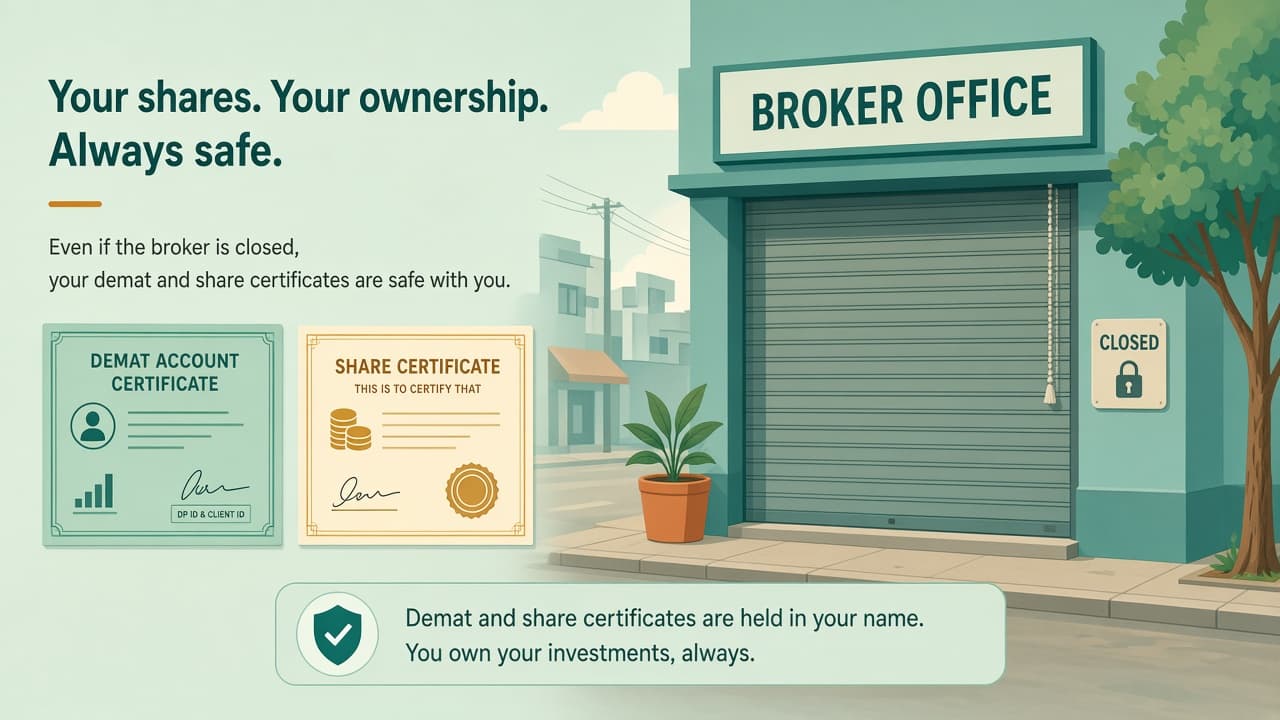
No. A broker's closure does not, by itself, cancel securities recorded in an investor's demat account.
India has two central securities depositories:
- CDSL — Central Depository Services Limited
- NSDL — National Securities Depository Limited
These depositories maintain electronic records of securities through the demat account system. Investors access their demat accounts through Depository Participants.
If a broker stops operating, investors may need to contact the relevant depository, Depository Participant or stock exchange to understand the next steps.
Depending on the situation, the process may include:
- Checking your latest demat account statement.
- Confirming your holdings and account status.
- Contacting the relevant institution through its official channels.
- Following the prescribed process to transfer holdings or restore access, if necessary.
The process may take time if the account is frozen, a transaction is pending, securities are pledged or a dispute exists.
You can find official investor information at CDSL and NSDL.
Remember: Your broker's app and your demat holdings are not the same thing.
Broker shut down? Remember these 3 pictures
1 / 3
1. App is only a doorway
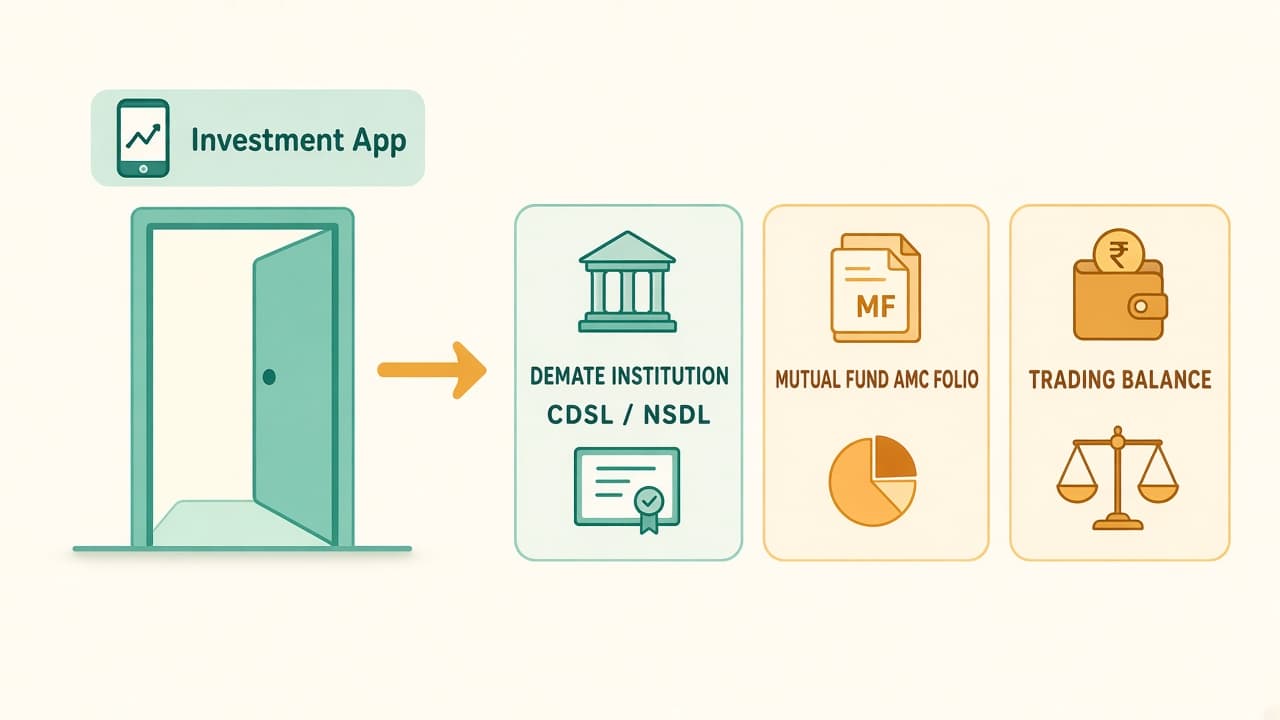
Your app helps you place orders. Different institutions maintain the records.
3. What Happens to Mutual Funds If a Demat Broker Closes?
This is where understanding how you hold your mutual funds becomes important.
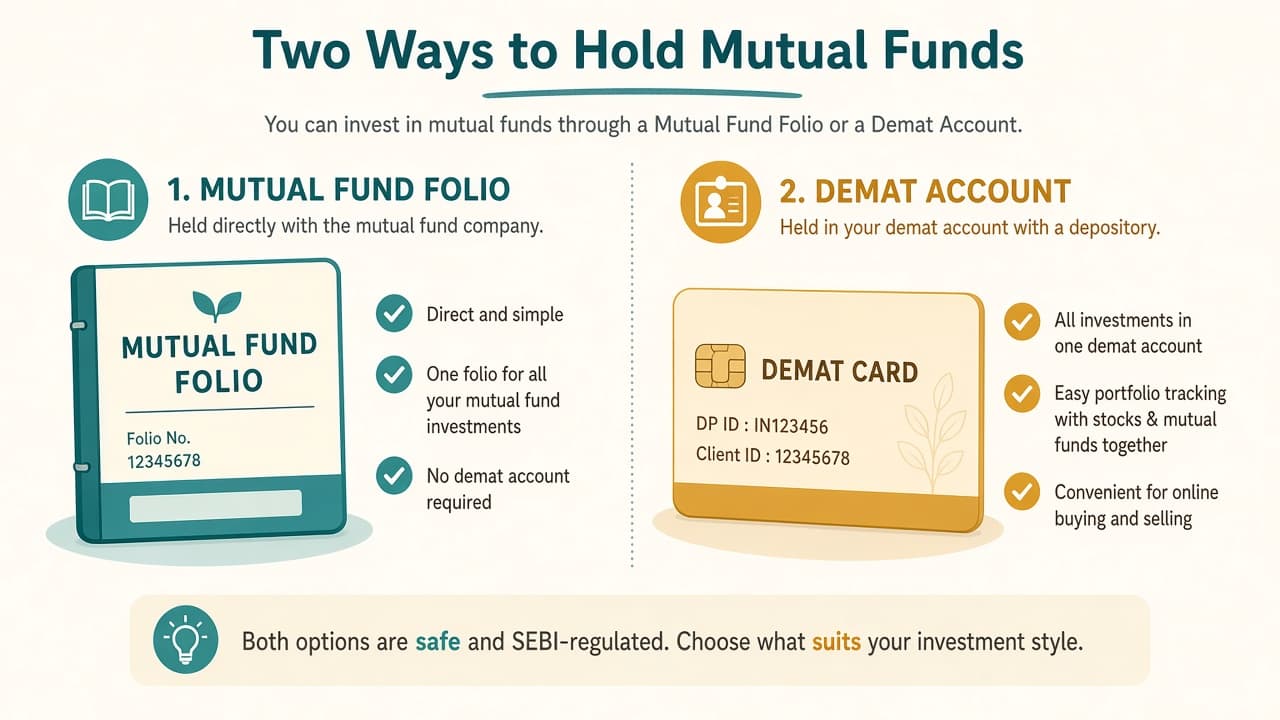
If you are searching for what happens to mutual funds if demat broker closes, the first thing to check is whether your mutual fund units are held in a folio or in demat form.
The two arrangements have different recordkeeping systems.
Case A: Mutual Funds Held in a Folio
When you invest in a mutual fund through a folio, your units are recorded in the mutual fund's records.
The Asset Management Company manages the fund. Its registrar and transfer agent may maintain investor records and provide services such as account statements and transaction processing.
Examples of Indian mutual fund houses include SBI Mutual Fund, HDFC Mutual Fund and ICICI Prudential Mutual Fund.
Suppose Rahul invested in mutual funds through an app, but his units were held in folios.
If the app shuts down, the closure does not automatically cancel those units.
Rahul can contact the relevant AMC or registrar to verify his holdings and understand how to access available services.
He should keep his PAN, folio number, registered mobile number and email address available.
Case B: Mutual Funds Held in Demat Form
Some investors hold mutual fund units in demat form.
In this case, the units are recorded in their demat accounts.
If the stockbroker's app becomes unavailable, the investor may need to contact the relevant Depository Participant or depository to confirm the holdings and understand how to access them.
The appropriate process depends on the account arrangement and the circumstances surrounding the broker's closure.
How Can You Check Your Mutual Fund Holdings?
You can explore the official services offered by:
- Your mutual fund's Asset Management Company.
- The relevant registrar, such as CAMS or KFintech, where applicable.
- MF Central, which provides mutual fund investor services.
- Your Depository Participant, if your mutual fund units are held in demat form.
The availability of particular services depends on how your investments are recorded.
The key lesson: An investment platform closing does not automatically mean your mutual fund units are lost. Knowing where your units are recorded helps you identify the appropriate institution to contact.
4. What About Money Sitting Unused in Your Trading Account?
Now let's look at a different situation.
Rahul has ₹50,000 in his trading account. He transferred the money from his bank account but has not yet used it to purchase shares.
Then his broker shuts down.
Will he receive the money back immediately?
Not necessarily.
Stockbrokers must follow regulatory requirements for handling client funds. However, a broker's financial failure can create complications if money is missing, records are disputed or the broker cannot meet its obligations.
The process for recovering outstanding balances depends on the circumstances and the applicable rules.
Here is a simple comparison.
| Asset | What Happens If the Broker Closes? |
|---|---|
| Shares in a demat account | The holdings do not automatically disappear. Access or transfer may require a formal process. |
| Mutual funds held in a folio | The units remain recorded in the mutual fund's records, subject to verification and any account-specific issues. |
| Mutual funds held in demat form | The units are recorded in the demat account and may require the relevant depository process to access. |
| Unused trading balance | Recovery depends on the available records, outstanding obligations and applicable procedures. |
What Is an Investor Protection Fund?
Recognised stock exchanges maintain Investor Protection Funds under the applicable regulatory framework.
These funds can provide compensation to eligible investors in certain cases involving a defaulting stockbroker.
However, compensation is subject to the relevant eligibility conditions, limits, claim procedures and other applicable rules.
An Investor Protection Fund is not a blanket guarantee that every investor will recover every rupee owed by a failed broker.
If your broker defaults, check the relevant stock exchange's official announcements and follow its instructions for submitting a claim.
You can find investor guidance on the SEBI Investor website.
5. Four Simple Habits That Help You Stay Prepared
You do not need to understand every technical detail of the financial system to keep track of your investments.
A few simple habits can help you stay organised.
Habit 1: Know Where Your Investments Are Recorded
For every investment, understand whether it is held in a demat account or a mutual fund folio.
Keep your account numbers and statements accessible.
Do not rely entirely on your investment app to remember what you own.
Habit 2: Check Your Statements Regularly
Review your demat statements, mutual fund statements and transaction records periodically.
If you notice a missing holding, an unfamiliar transaction or a mismatch, contact the relevant institution through its official channels.
Keeping your records organised can also help you identify discrepancies and provide supporting documents if a problem arises.
Habit 3: Keep Your Contact Details and Nominee Information Updated
Make sure your registered mobile number, email address and other account details are current.
Review the nominee details associated with your demat accounts and mutual fund holdings.
Understanding nomination rules and keeping your records updated can help your family navigate account-related formalities when necessary.
Habit 4: Know How to Access Your Investments Without the App
Find out which institution maintains your investment records and how to contact it directly.
Explore the official investor services provided by CDSL, NSDL, your mutual fund house and relevant registrars.
You can also check whether MF Central provides the services you need for your mutual fund holdings.
The aim is simple: you should know where to look if your usual app becomes unavailable.
6. What Should You Do If Your Broker Actually Defaults?
Knowing what to do before a problem arises is useful. Knowing where to turn when a problem occurs is equally important.
If your broker stops operating or is declared a defaulter, avoid relying on rumours or unofficial messages.
Instead:
Step 1: Check official announcements.
Visit the relevant stock exchange's website to confirm the broker's status and read the instructions issued to investors.
Step 2: Collect your records.
Keep your account statements, transaction records, contract notes and details of any outstanding balance available.
Step 3: Follow the prescribed claim process.
If the exchange invites claims from affected investors, follow its instructions and submit the required documents within the applicable deadline.
Step 4: Check the status of your claim.
Use the official claim-status facility provided by the relevant exchange, where available.
Step 5: Escalate unresolved complaints through official channels.
Follow the exchange's grievance process and, where appropriate, use SEBI's SCORES complaint platform.
The process and available remedies depend on the circumstances. Not every broker closure is treated as a formal default, and not every claim is necessarily eligible for compensation.
For the current regulatory framework, consult SEBI's Stock Brokers Regulations, 2026.
7. Your Quick Investor Checklist
Before you close this article, ask yourself:
- Do I know which Depository Participant maintains my demat account?
- Can I access my latest demat account statement?
- Do I know whether my mutual fund units are held in a folio or demat form?
- Are my registered contact details and nominee information up to date?
- Do I know where to find official instructions if my broker stops operating?
- Do I know how to check my holdings without depending entirely on my investment app?
If you cannot answer every question today, take some time to locate your statements and understand how your investments are recorded.
You do not need to wait for a problem to arise before learning how to access your own financial records.
The Bottom Line: Your Investments Are More Than an App on Your Phone
A financial app makes investing convenient. You can view your portfolio, place orders and track transactions from a single screen.
But the app is only one part of a larger financial system.
Shares, mutual fund units and unused trading balances are handled differently under the applicable rules.
A broker shutting down does not automatically mean that all your investments are lost. However, accessing your holdings, transferring securities or recovering outstanding money may require additional steps.
The best starting point is awareness: know where your investments are recorded, keep your statements accessible and understand the official process for resolving problems.
Because financial awareness is not just about understanding where to invest. It is also about knowing how your investments are recorded and how to access them when something goes wrong.
Official Sources and Further Reading
The following official resources can help readers verify the information in this article and learn more.
- SEBI Investor Charter: Investor rights, responsibilities and broker-default guidance
- SEBI Stock Brokers Regulations, 2026: Official regulatory framework
- CDSL: Official depository and investor services
- NSDL: Official depository and investor information
- AMFI: Mutual fund investor information
- MF Central: Mutual fund investor services
- SEBI SCORES: Official investor complaint platform
Readers should check the latest rules and instructions published by the relevant institution before taking action.
About FinBites
FinBites.org is an independent financial education initiative that makes money-related concepts easier to understand through simple, accessible learning.
Our goal is to help people of different ages and backgrounds understand financial systems, financial terms and important money concepts without unnecessary jargon.
FinBites provides financial education, not financial product recommendations.
Disclaimer: This article is for general educational and informational purposes only. It does not constitute financial, investment, legal or tax advice and does not recommend any broker, mutual fund, security or financial product. Regulations, procedures and eligibility conditions may change. Readers should verify current requirements with the relevant regulator, stock exchange, depository, mutual fund house or authorised service provider.
Found this useful?
Forward it to one person who needs it today — a parent, a friend, a colleague.
© FinBites.org · Educational use only · Do not republish without permission. Terms of Service